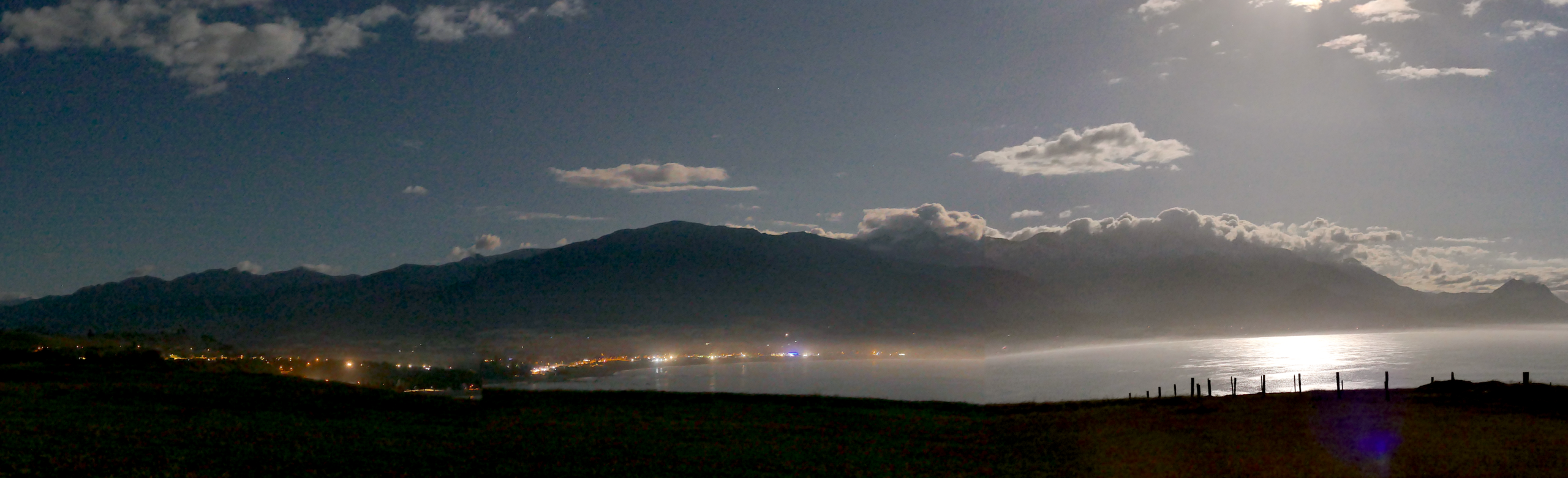
Significant lighting upgrades completed along State Highway 1 in Kaikōura are being welcomed as a crucial step towards the town achieving international Dark Sky Community accreditation.
The lighting upgrades by New Zealand Transport Agency Waka Kotahi (NZTA), working alongside the Kaikōura Dark Sky Trust, are also expected to bring benefits for local wildlife while supporting night-time safety for road users and pedestrians.
The project was initiated by Colin Knaggs from NZTA as part of Kaikōura’s post-earthquake recovery, with a vision to future proof key sections of SH1 in a way that aligned with best practice outdoor lighting and supported Kaikōura’s dark sky journey.
Kaikōura’s 2024 International Dark Sky Sanctuary accreditation highlighted the district’s dedication to reducing unnecessary and unshielded artificial light, enhancing natural darkness, and preserving ecological values. The SH1 retrofit reflects this shared ambition. These upgrades move Kaikōura township (which is not part of the Sanctuary) closer to its aspiration of applying for Dark Sky Community accreditation through DarkSky International.
“Kaikōura is deeply proud of its natural heritage, and these upgrades show what’s possible when a national agency demonstrates genuine commitment,” says Will Doughty, CEO of Kaikōura District Council. “NZTA has gone beyond standard requirements to support our long-term dark sky goals, and we’re grateful for the way they’ve worked alongside our passionate community.”
As part of the design process, NZTA reviewed the known flight paths of Hutton’s shearwaters, a unique and endangered species, to ensure that warm 2200 Kelvin LED colour temperatures were used in the most sensitive areas. While the retrofit was not undertaken solely for seabird protection, the design choices provide welcome additional environmental benefits.
“NZTA is pleased to have taken extra steps that may help reduce risks for these endangered seabirds while supporting Kaikōura’s wider environmental ambitions,” says Gavin Lake, NZTA project manager. “While outcomes can’t be guaranteed, we are hopeful these improvements will contribute positively to the environment whilst providing modern, efficient and low-maintenance road lighting for the safe passage of vehicles and pedestrians.”
Upgraded Lighting Specifications
The luminaires installed by NZTA include several design features that exceed local outdoor lighting regulations and strongly support dark sky principles:
- Warm colour temperature LEDs (2,200K–2,700K)
- Precision lens optics directing light downwards and only where needed
- Full shielding and low-glare design preventing upward and lateral spill
- Horizontal (0°) installation to eliminate sky glow caused by tilt
- Network connectivity for remote fault reporting to assist maintenance.
“Every small change in light intensity, direction, and colour can make a meaningful difference,”
says Dr Larry Field, a retired scientist who worked extensively on the project on behalf of the Kaikōura Dark Sky Trust. “The combination of horizontal fittings, warm colour temperatures, and highly controlled optics represents a thoughtful, evidence-based approach, and the Trust appreciates the extra care taken in the lighting design.”

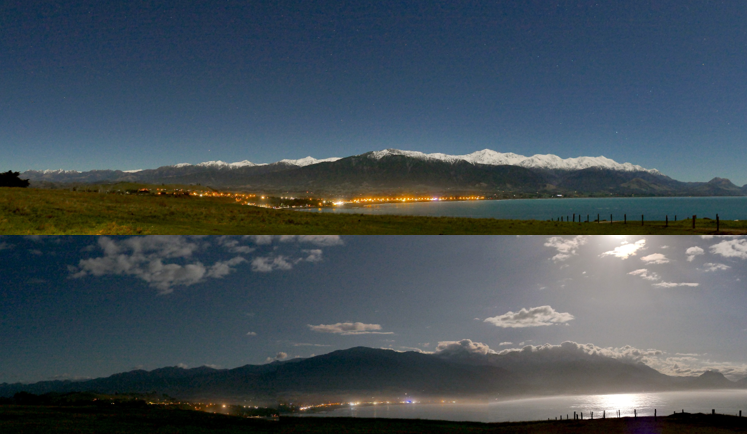
Note the small downward directed amber light cones from the new SH1 lights which can been seen from the centre to the left as an excellent example of the dark sky approach: directing night lighting only to the area of use, rather than unnecessary broadcasting light where it is not needed.
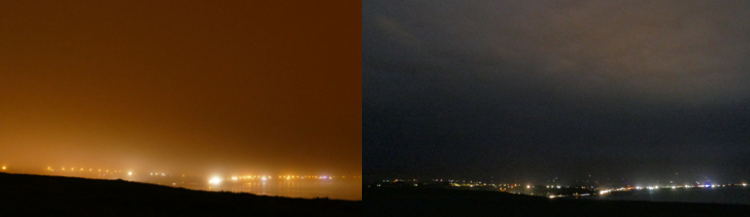
Water particles in clouds and atmospheric haze repeatedly refract light in all directions through adjacent particles, causing enormous outward and upward spread from original height and direction of the luminaire.
In Summary
The post-retrofit photo shows the major advantages of the new horizontally shielded LED luminaires. The upward light escape is essentially eliminated, and this has removed the night sky pollution as well as the reflected light scatter from the sea.
Looking Ahead
The completion of this NZTA project, alongside the earlier council streetlight retrofit, represents a strong step forward for Kaikōura. Together, these upgrades help protect the district’s mountain-to-sea setting, reduce unnecessary light spill, and support both environmental values and safer night-time travel for drivers and pedestrians in the town.
The images also highlight opportunities for further improvement, particularly in areas where older, unshielded bright lighting remains. The Trust looks forward to working constructively with other agencies, local businesses, and the wider community to continue improving lighting outcomes across Kaikōura.
Photos taken by Dr Larry Field