
A Kaikōura Dark Sky Trust project with local dairy farmers has demonstrated how relatively simple changes to outdoor lighting can significantly reduce glare and light pollution without compromising safely or farm operations.
Lighting is an essential part of dairy farming, particularly during early morning and evening operations at the shed. Traditional outdoor floodlights send significant amounts of light beyond the area where it is actually needed, creating glare, light spill and unnecessary illumination of the surrounding night environment. The Kaikōura Dark Sky Trust set out to see whether there was a practical alternative.
Working with local dairy farmers and electrician Dan Farr from Dan The Sparky, the Trust identified several dairy sheds, within the flight path of the Hutton’s shearwater, where existing exterior floodlights could be replaced with dark sky compliant alternatives.
The project has now seen four replacement floodlights installed across three Kaikōura dairy sheds, providing some striking before and after results.
What makes the new lighting different?
Dark sky lighting isn’t about removing useful light, it’s about shining light only where it’s needed.
The replacement lights used for the project are fully shielded, warm 3000 Kelvin LED fittings which meet the new Council outdoor lighting standards. Rather than throwing light upwards and outwards, the fittings concentrate it down onto the yard area.
For outdoor farm lighting, there are three simple principles: Direct it down. Keep it warm. Don’t use more light than you need.
This is particularly important in Kaikōura, where reducing unnecessary artificial light contributes to protecting our internationally recognised dark skies and can help reduce disturbance to nocturnal wildlife, including the endangered Hutton’s shearwater.
Seeing the difference
Perhaps the most powerful part of the project has been seeing the results of the three case studies.
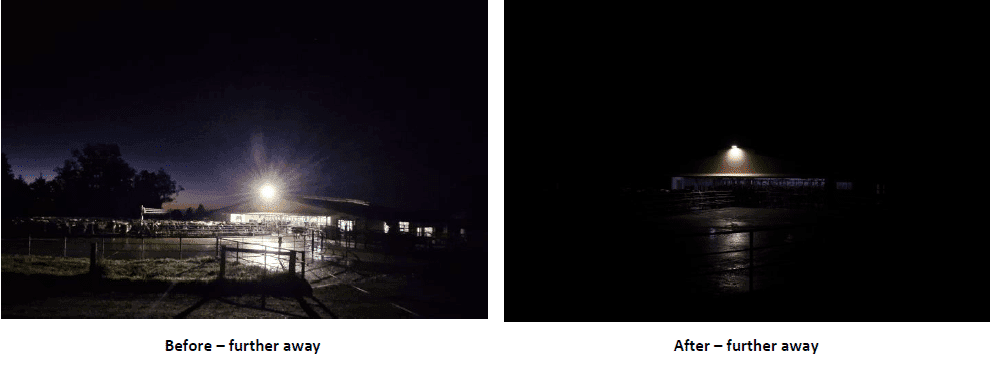
At Sequoia Dairy Shed the original exposed floodlight created significant glare and was clearly visible well beyond the immediate dairy shed. After the replacement light was installed, the difference was striking. The working area remained illuminated, but the light was concentrated on the yard, with considerably less glare and light escaping into the surrounding darkness.
Case study 1: Sequoia Dairy Shed
Case study 2: Rockwood Dairy Shed
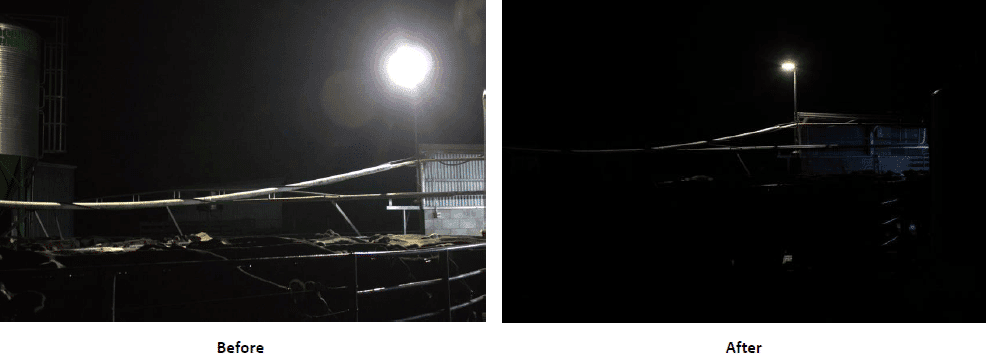
Quote from Mylor Dairy Ltd Operations Manager Justin Hocking “This project has done a fantastic job at reducing the light pollution from our two dairy sheds without hindering our operations. In fact, there are a couple of hidden benefits such as reduced electricity usage and a far less intrusive light, which the workers and cows enjoy.”
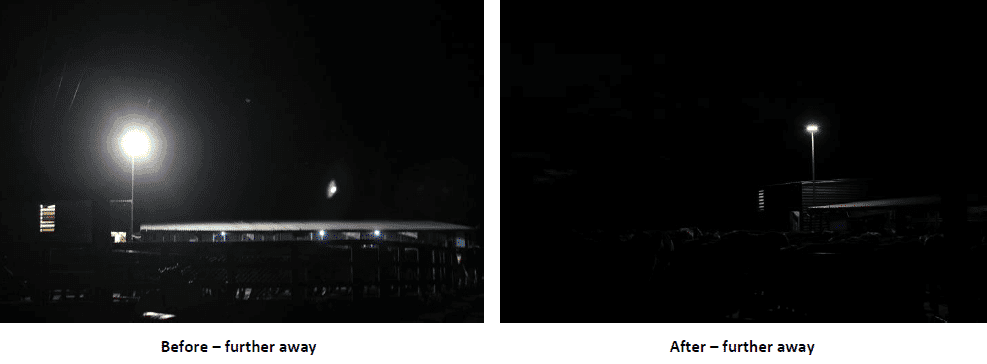
A third installation at the Boyd Dairy Shed on Old Beach Road produced another obvious improvement. The original light was highly visible from a distance and produced substantial glare. The replacement fitting is much less intrusive, and warmer in colour, while continuing to illuminate the yard below.
Case study 3: Boyd Dairy Shed
What did we learn?
One of the most useful outcomes of the project has been learning that dark sky compliant lighting doesn’t negatively affect farm operations.
Before any lights were replaced, the Trust talked with farmers about how their existing lighting was used and what they needed to see to operate safely.
Two dairy sheds initially considered for the project were ultimately not progressed because the farmers wanted their lights to illuminate areas well beyond the immediate dairy yard.
Fully shielded lights are very effective at directing light down and reducing glare and spill, but that also means they don’t throw light across a wide area in the same way as an upward tilted floodlight. Achieving the same coverage at those farms would have required additional fittings and wasn’t achievable within the project budget.
Interestingly, having now seen the results at the demonstration farms, we believe some farmers may reconsider how much surrounding light they actually need.
That experience reinforced something important: start by asking what the light needs to do, rather than simply replacing one fitting with another.
Sometimes the best light is no light
The project has also highlighted another option that costs nothing at all.
Over recent years, several farmers approached by the Trust have decided simply not to use their exterior dairy yard lights and they have found them unnecessary.
Quote from Simon Mackle, local dairy farmer, “I used to think that the cows needed to be illuminated out in the cowshed yard, which meant they would walk into the parlour in a timely fashion. Our outside lights are powerful and at times, particularly on foggy mornings, I could see hundreds of Hutton’s shearwaters circling above the lights which obviously wasn’t helpful for the birds as they were meant to be flying out to sea for their breakfast. After seeing publicity about the Dark Sky Project a few years ago we turned our outside lights off and it made no difference to the cow flow. They still came in the same. As someone who is up early our night skies are pretty special. I feel the lights were causing light pollution, affecting our neighbours and how well people in Kaikoura can see the night sky. Long story short, we have realised we don’t need our outside lights, so we don’t use them. The saving on energy costs is an additional bonus”.
This is a great example of one of the simplest principles of responsible outdoor lighting: if a light isn’t needed, turn it off.
How much does an upgrade cost?
For the demonstration project, the approximate cost was $500 per light to purchase and retrofit, although costs will naturally vary depending on the fitting, installation and individual site.
Dan Farr from Dan The Sparky says upgrading existing farm lighting doesn’t necessarily need to be complicated. “Retrofitting existing farm lighting to meet the dark sky standards doesn’t need to be a big or expensive job. In many cases it’s simply a matter of replacing the existing floodlight with a fully shielded, warm LED fitting. The upfront cost is relatively small, and because modern LEDs use less power and last longer, there are ongoing energy and maintenance savings over the life of the fitting.” — Dan Farr, Dan The Sparky
A practical example for other farms and businesses
This was a relatively small demonstration project, but the results provide a useful local example of what can be achieved.
Protecting Kaikōura’s night sky doesn’t mean removing lighting that farmers and businesses need. In the right location, a straightforward retrofit can significantly reduce glare and light spill while continuing to provide useful working light.
If you’re considering replacing an outdoor light, start with a few simple questions:
Where do I actually need the light? How far does it need to reach? What do I need to be able see? Also, could a timer or motion sensor be used instead?
Every individual lighting change may seem small, but collectively they make a real contribution to protecting Kaikōura’s dark night environment.
Thank you to our amazing funders and supporters
To Dan Farr of Dan The Sparky for his guidance and generosity with his time and particularly to the participating farmers willing to trial a different approach to exterior lighting.
The Kaikōura Dark Sky Trust would like to thank Kaikōura District Council, which supported the project through their Discretionary Fund and Fonterra, through their Doing Good Fund.
FONTERRA
“Fonterra is proud to support practical, community-led initiatives like this one from the Kaikōura Dark Sky Trust. It’s a great example of how relatively simple changes can deliver positive environmental outcomes while still meeting the needs of a working dairy farm. By demonstrating what can be achieved in a real farming environment, we hope the project encourages other farmers to consider whether small changes to their outdoor lighting could make a difference too.”
- Sam McCulloch, Regional Manager, Farm Source Tasman / Marlborough
KAIKOURA DISTRICT COUNCIL
“It’s been fantastic to see local farmers willing to get behind this initiative and trial a different approach. The results speak for themselves and demonstrate what can be achieved when our community works together to protect Kaikōura’s special night sky.”
- Will Doughty, Chief Executive, Kaikōura District Council and Trustee, Kaikōura Dark Sky Trust